Sigiriya Frescoes: Who Are the Women in the Paintings?
Halfway up one of Sri Lanka’s most famous ancient monuments, a group of mysterious women has looked out from the rock face for around 1,500 years.
Decorated with jewellery, elaborate hairstyles and flowers, they are among the most recognisable images associated with Sigiriya. Yet one seemingly simple question remains surprisingly difficult to answer:
Who are they?
Where Are the Sigiriya Frescoes?
The surviving paintings are located in a sheltered recess high on the western face of Sigiriya Rock.
Their location is remarkable. These paintings were not created inside a conventional room or temple chamber. They appear directly on the enormous rock face, high above the surrounding landscape.
This placement also connects them visually and historically with the wider royal complex that once occupied Sigiriya. To understand that setting, explore what Sigiriya looked like 1,500 years ago.
When Were the Paintings Created?
The Sigiriya frescoes are generally dated to the 5th century CE and are associated with the period when King Kashyapa I transformed Sigiriya into a royal capital.
Kashyapa ruled from 477 to 495 CE.
The frescoes were therefore part of a much larger architectural and artistic project rather than isolated paintings.
What Do the Women Look Like?
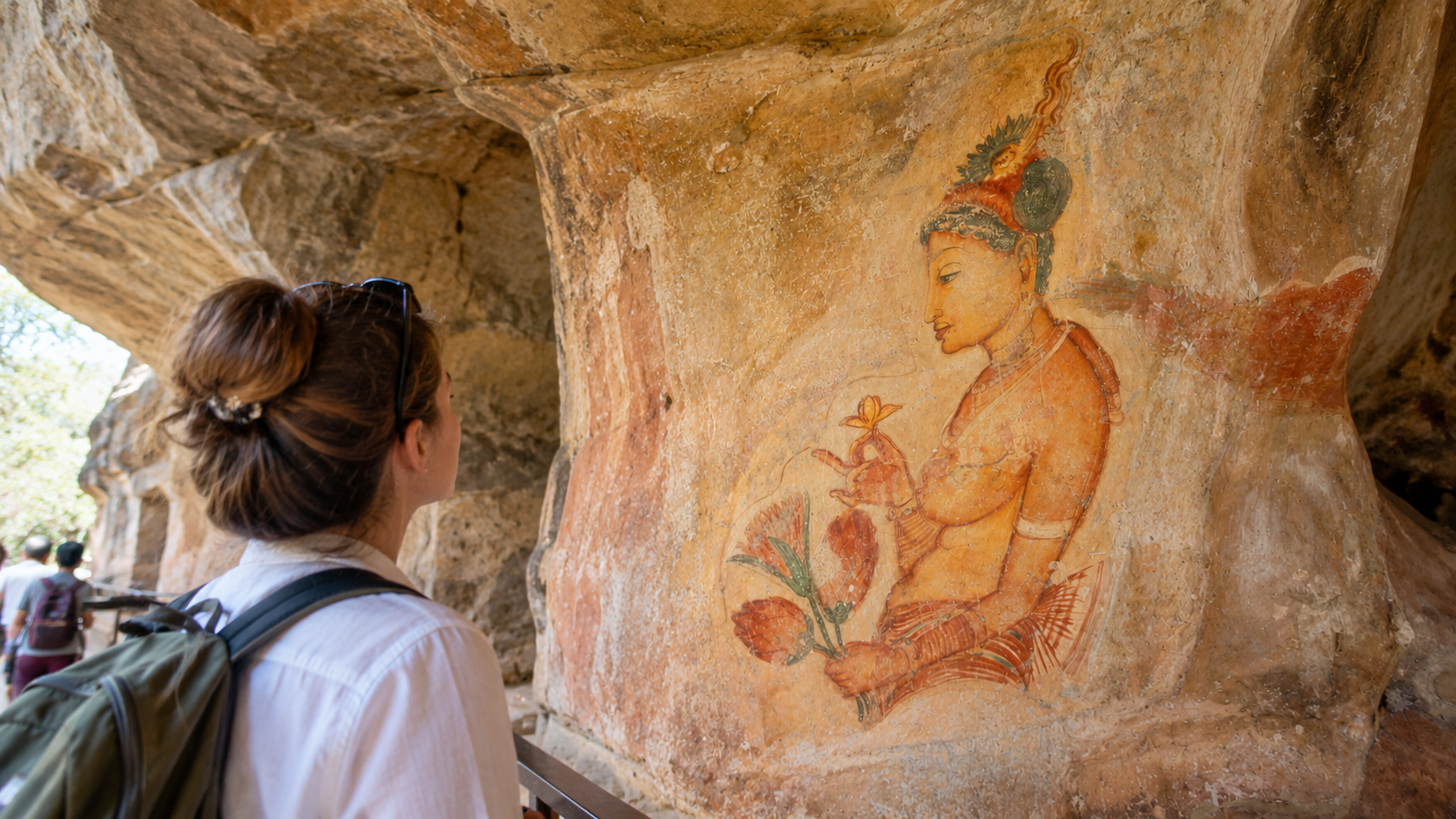
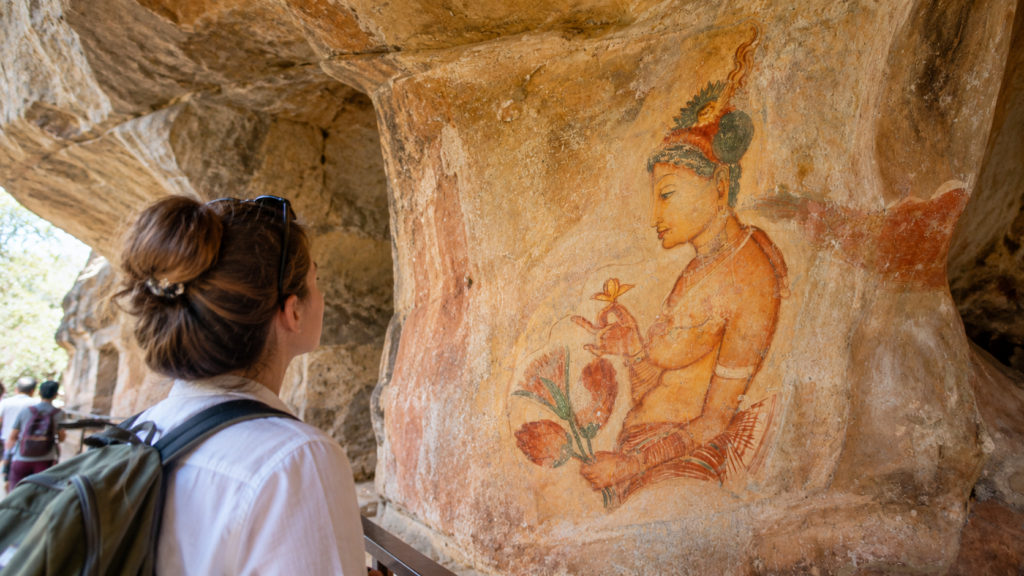
The surviving figures are painted from approximately the waist or chest upward.
They wear elaborate jewellery, including necklaces, bracelets and ornaments. Their hairstyles are carefully arranged, and many hold or carry flowers.
The figures seem to emerge against a relatively plain background, which contributed to later descriptions of them as “cloud maidens.”
Their sophisticated modelling, expressive gestures and use of colour demonstrate the high level of painting associated with 5th-century Sigiriya.
Who Are the Women in the Sigiriya Frescoes?
There is no universally accepted identification of the women.
Several interpretations have been proposed.
Celestial Maidens or Apsaras
One of the best-known interpretations is that the women represent apsaras, celestial female beings found in South Asian religious and artistic traditions.
Their elevated position on the rock, elegant appearance and seemingly floating presentation have helped support this interpretation.
Queens and Royal Women
Another interpretation suggests that the paintings represent women connected to King Kashyapa’s royal court, including queens or consorts.
Their jewellery and elaborate appearance can be read as signs of high social status.
Divine or Religious Figures
Other interpretations connect the women with goddesses or religious imagery.
Sigiriya’s history did not begin with Kashyapa. Buddhist monastic communities had occupied rock shelters around the area centuries before the royal city was constructed, and the site returned to monastic use after Kashyapa’s reign.
What Do the Mirror Wall Poems Tell Us?
One of the most fascinating clues comes from people who visited Sigiriya centuries after Kashyapa.
These writings show that the paintings had already become an attraction long after Sigiriya stopped functioning as Kashyapa’s royal capital.
The poems are now important evidence for both Sri Lankan literary history and the long cultural impact of the paintings.
Read more about Sigiriya’s Mirror Wall and why it was created.
Why Have the Paintings Survived?
Their sheltered position has offered some protection, but surviving for around fifteen centuries on an exposed rock monument has not been simple.
UNESCO and Sri Lankan heritage authorities have studied issues including discoloration, moisture, previous repairs and changes to the painted surfaces. Conservation work therefore focuses on understanding the original materials and environmental conditions rather than simply repainting damaged areas.
How Do the Frescoes Fit Into Ancient Sigiriya?
The paintings make more sense when viewed as one part of an extraordinary designed landscape.
Below them were formal gardens and sophisticated water systems. Above them stood the summit palace. Nearby were the Mirror Wall, galleries and monumental Lion Gate.
The Sigiriya water gardens demonstrate just how carefully architecture, landscape and engineering were combined throughout the complex.
Conclusion
The mystery surrounding the Sigiriya frescoes is part of what makes them so fascinating.
The women may represent celestial maidens, members of a royal court, divine figures or an artistic idea whose full meaning has been lost with time. No interpretation has been proven conclusively.
Visitors climbing the rock today see only a small surviving portion of what was once a much larger composition. Even so, the mysterious women of Sigiriya remain among the most memorable figures in Sri Lankan art.