Dambulla Cave Temple: What Is Inside the Five Caves?
Climb the rock above Dambulla and a row of simple white entrances hides one of Sri Lanka’s richest collections of Buddhist art.
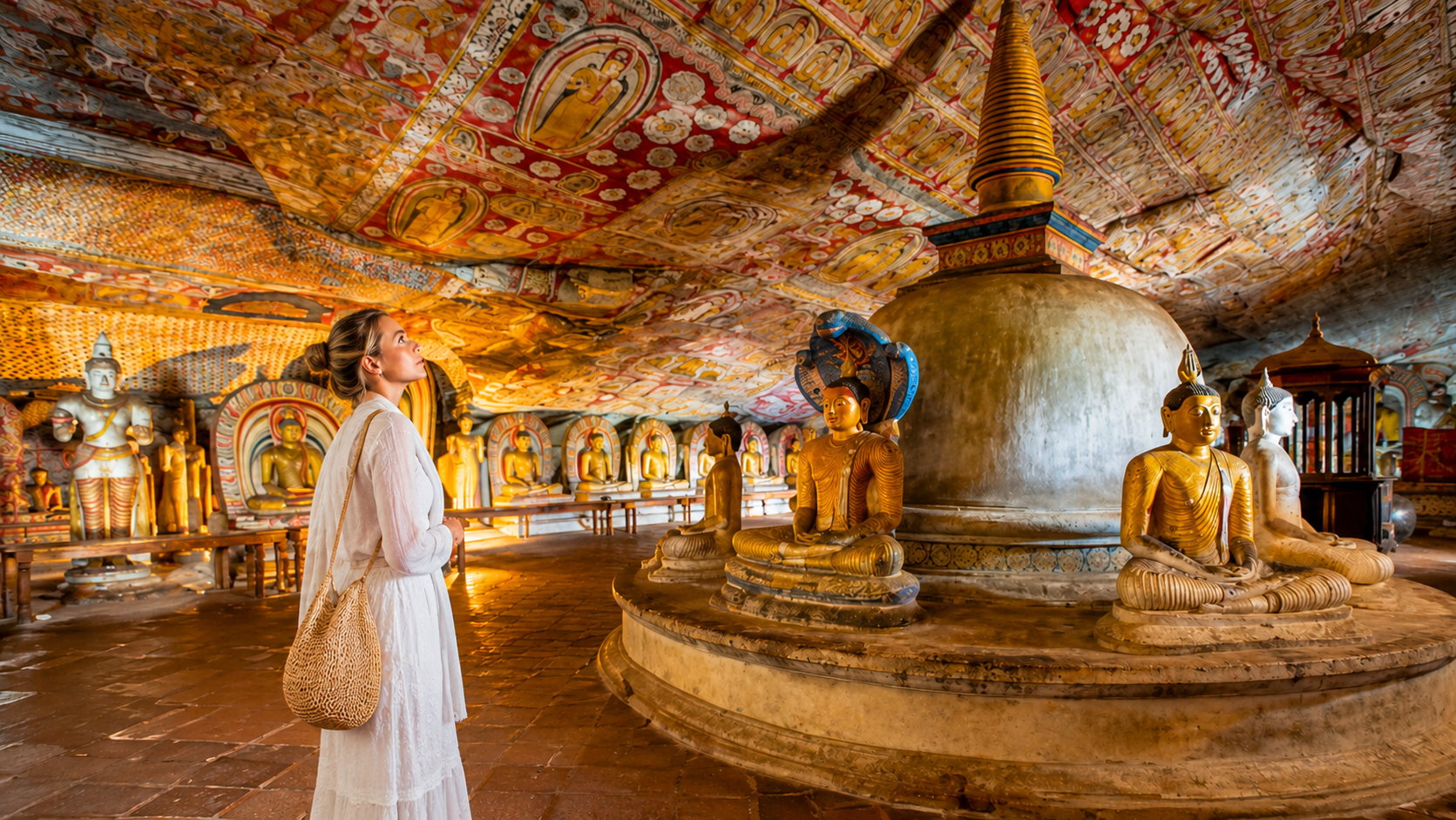
The Dambulla Cave Temple contains five main cave shrines filled with Buddha statues, painted ceilings, religious scenes and centuries of artistic additions. Together, the caves contain 157 statues, while paintings cover approximately 2,100 square metres of walls and ceilings.
How Old Is Dambulla Cave Temple?
The history of Dambulla Cave Temple stretches back more than 2,000 years.
Buddhist monks were using natural caves around Dambulla from at least the 3rd century BCE. The upper caves were later transformed into shrines, traditionally associated with King Vattagamani Abhaya, commonly known as King Valagamba, in the 1st century BCE.
King Nissanka Malla contributed to its development in the 12th century, while major restoration and artistic work took place during the Kandyan period, particularly in the 18th century.
Cave 1: Devaraja Viharaya
The first cave is known as Devaraja Viharaya, or the Temple of the King of Gods.
Its dominant feature is impossible to miss: a reclining Buddha approximately 14 metres long.
The enormous figure was carved from the living rock and occupies much of the cave’s interior. It represents the Buddha in the reclining position associated with his passing into parinirvana.
Cave 2: Maharaja Viharaya
The second cave, Maharaja Viharaya, or Temple of the Great Kings, is the largest and most impressive of the five.
It stretches roughly 52 metres across and reaches approximately 23 metres into the rock.
Dozens of Buddha images occupy the interior in standing, seated and reclining positions. Images associated with kings and deities are also found within the cave.
The ceiling and walls are covered with paintings depicting Buddhist subjects and episodes connected with Sri Lankan Buddhist history.
The scale of Cave 2 makes it the centrepiece of the Dambulla Cave Temple experience.
Cave 3: Maha Alut Viharaya
The third cave is called Maha Alut Viharaya, meaning the Great New Temple.
This cave is particularly associated with the major 18th-century refurbishment of Dambulla during the Kandyan period and contains around 50 Buddha images.
The walls and ceiling are densely painted in the characteristic style associated with Kandyan Buddhist art.
Cave 4: Pachima Viharaya
Cave 4 is known as Pachima Viharaya, or the Western Temple.
It is considerably smaller than the great second and third caves.
Inside are several Buddha images arranged around a small stupa, or dagoba. The cave continues the visual pattern found throughout the complex, where sculpture, painting and the natural rock surface work together to form a sacred interior.
Cave 5: Devana Alut Viharaya
The final shrine is Devana Alut Viharaya, meaning the Second New Temple.
It represents one of the later phases in the development of the cave complex.
The interior contains Buddha images, including a large reclining figure, alongside painted surfaces and figures associated with the wider religious traditions represented at Dambulla.
Why Are There So Many Paintings?
One of the most extraordinary features of Dambulla Cave Temple is that architecture and painting are almost inseparable.
UNESCO records approximately 2,100 square metres of mural paintings across the complex, making them one of Dambulla’s defining features.
The five caves also contain 157 statues of different sizes, including figures carved directly from rock as well as moulded and painted sculptures.
Is Dambulla Cave Temple Still Used for Worship?
Yes.
Dambulla Cave Temple is not simply an archaeological monument. It remains an active Buddhist religious site and pilgrimage destination.
UNESCO describes it as a living Buddhist site with a continuous tradition of worship extending for more than two millennia.
Travellers staying around Sigiriya can also explore where to stay near Sigiriya, Dambulla or Kandalama when deciding which area makes the most convenient base.
For another look at Dambulla’s atmosphere beyond the cave interiors, read A Morning at Dambulla Cave Temple.
Why Is Dambulla a UNESCO World Heritage Site?
UNESCO inscribed the site on the World Heritage List in 1991.
Its importance comes not only from its age but from the extraordinary preservation and scale of its religious art. UNESCO recognises it as Sri Lanka’s largest and best-preserved cave-temple complex.
Conclusion
The five caves of Dambulla Cave Temple reveal different chapters of the same long story.
Together, the five caves preserve more than statues and paintings. They show how one natural rock shelter evolved into a living place of Buddhist worship that has remained significant for more than 2,000 years.