
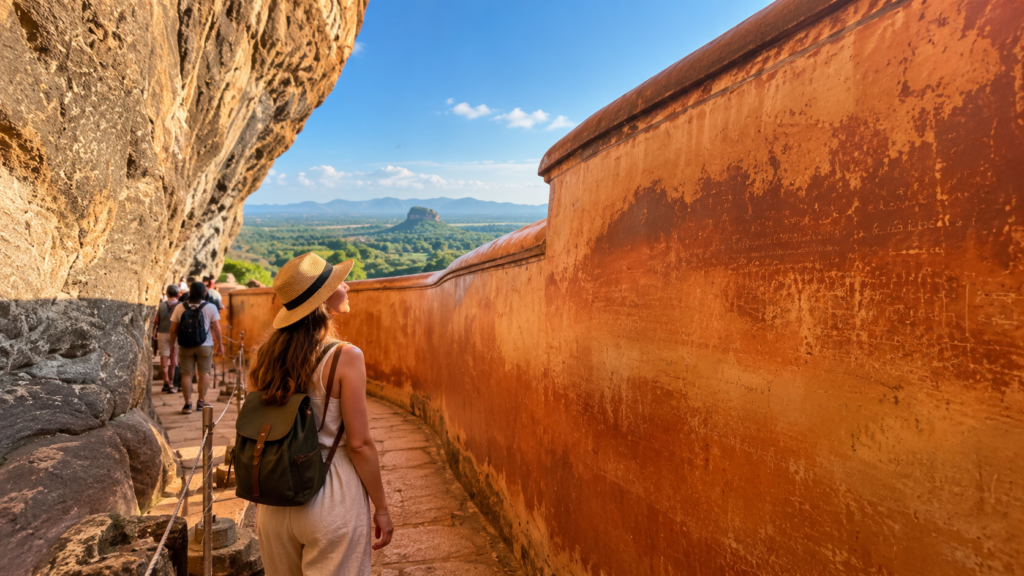
Halfway up Sigiriya Rock, between the gardens below and the ancient palace above, visitors encounter one of the site’s most unusual surviving features.
The Sigiriya Mirror Wall is a curved masonry wall that follows part of the elevated pathway around the western side of the rock. Today, it is famous for the ancient writing preserved on its surface. But those inscriptions were not the reason the wall was originally built.
Its story begins with the architecture of King Kashyapa’s 5th-century royal complex.
Why Was the Sigiriya Mirror Wall Created?
The Sigiriya Mirror Wall formed the outer side of an elevated gallery built against the rock face.
This gallery was part of the route leading through the royal complex towards the Lion Platform and eventually the summit. The wall functioned as a parapet beside the pathway while also contributing to the carefully designed appearance of the route.
Its inner surface was covered with fine plaster and polished until it developed an unusually smooth, reflective finish.
This polished surface is what eventually gave the structure its modern name: the Mirror Wall.
Was It Really Like a Mirror?
The name can create the impression of a modern glass mirror. That is not quite what visitors should imagine.
The wall was made from brick masonry and finished with highly polished plaster. Historical descriptions suggest the surface once had a much stronger sheen than it does today.
Tradition holds that it was polished enough for the king to see his reflection while passing beside it.
The Sigiriya Mirror Wall therefore offers another example of the technical skill found throughout the complex.
Its Connection to the Sigiriya Frescoes
The location of the wall is especially important.
Above the gallery are Sigiriya’s famous paintings of female figures. The exact identities and meaning of these figures remain debated, with interpretations ranging from celestial beings to women associated with the royal court or religious activity.
What is clear is that later visitors were fascinated by them.
As Sigiriya attracted visitors in the centuries following King Kashyapa’s reign, people began recording their reactions on the polished wall below.
Ancient Visitors Began Writing on the Wall
The inscriptions now known as the Sigiriya graffiti were added after the royal period.
Visitors carefully scratched short poems, observations, names and personal reactions into the plaster. Many responded to the women depicted in the paintings, while others expressed thoughts about beauty, love and the experience of visiting Sigiriya.
Hundreds of these writings have been studied, with surviving inscriptions spanning several centuries.
They are particularly important because they preserve early examples of written Sinhala and provide evidence about language, literacy and literary expression in medieval Sri Lanka.
The Mirror Wall Became an Ancient Visitor Book
In modern terms, the wall eventually functioned almost like a visitor book — although that was never its original purpose.
People arrived at Sigiriya, admired the paintings and landscape, and left their reactions behind.
Some identified themselves. Others composed poetry.
The writers were not all from one social group. Historical study of the inscriptions points to visitors from different backgrounds, making the wall an unusually personal historical record.
This is part of what makes the Sigiriya Mirror Wall so different from the site’s palaces and monumental structures.
How Does It Fit Into the Rest of Sigiriya?
The Mirror Wall should not be viewed as an isolated attraction.
It belonged to a carefully organised journey through the royal complex.
The site’s Sigiriya destinations guide provides more context for exploring the wider area around the fortress.
The broader landscape is equally important when understanding the scale of the ancient city. Travellers interested in how the fortress may originally have appeared can also explore what Sigiriya looked like 1,500 years ago.
Another remarkable example of Sigiriya’s planning can be found in the Sigiriya water gardens, where pools, channels and hydraulic engineering formed part of the royal landscape below.
Can Visitors Write on the Mirror Wall Today?
No.
The historical inscriptions are protected archaeological evidence. Adding new writing would damage both the ancient plaster and the centuries-old graffiti already preserved there.
Modern visitors should therefore observe the wall without touching, scratching or marking its surface.
What was once casual writing by medieval visitors has become an irreplaceable historical record.
Conclusion: Why the Sigiriya Mirror Wall Matters
The Sigiriya Mirror Wall was not created as a place for ancient graffiti.
It began as a beautifully finished parapet along an elevated pathway within King Kashyapa’s royal complex. Its polished plaster added refinement to the dramatic route around the rock.
Centuries later, visitors gave the wall another purpose.
Their poems and observations transformed it into one of Sri Lanka’s most unusual historical records, preserving not only an ancient architectural surface, but also the thoughts of people who stood at Sigiriya many centuries ago.