Look at Sigiriya today and you see the remains of something extraordinary.
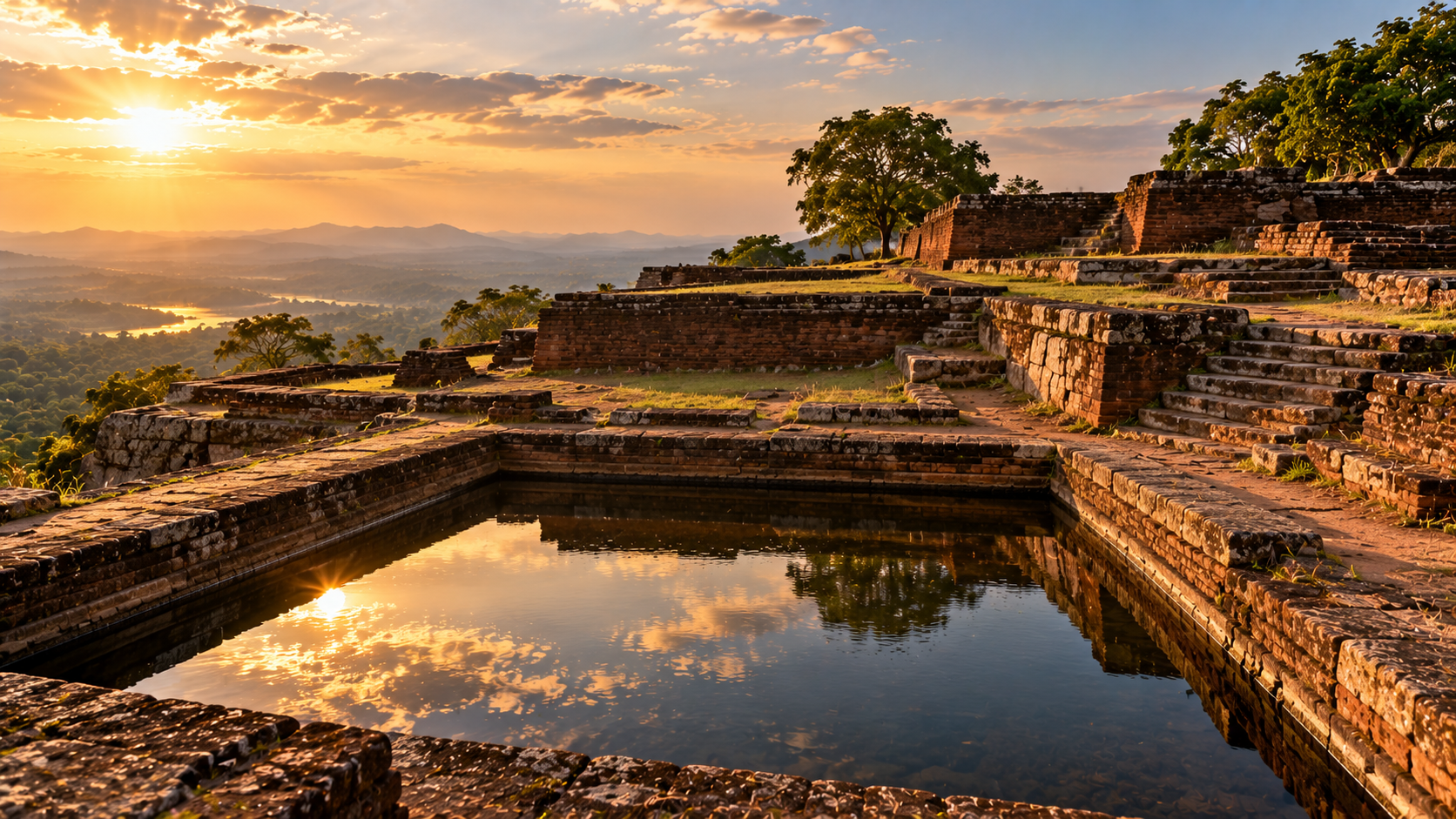
Brick foundations cover the summit. Ancient pools sit between ruined walls. Two enormous lion paws guard the final ascent. Below, geometric gardens stretch away from the rock.
But what did Sigiriya look like when all of this was still in use?
Travel back roughly 1,500 years to the late fifth century and the experience would have been dramatically different.
Sigiriya Was a Royal City, Not Just a Rock
One of the biggest differences between modern Sigiriya and Sigiriya 1,500 years ago is scale.
Today, attention naturally goes straight to Lion Rock.
In the fifth century, the rock was the dramatic centrepiece of a much larger planned environment.
Under King Kassapa I, who ruled from 477 to 495 CE, Sigiriya was developed as a royal capital incorporating fortifications, gardens, water systems, buildings, art and an elevated palace complex.
The wider site included moats and ramparts, formal gardens, residential and royal areas, pathways, pavilions and sophisticated hydraulic infrastructure.
So when imagining ancient Sigiriya, don’t picture a palace sitting alone on a rock.
Picture an entire royal landscape built around it.
The Water Gardens Were Full of Movement
The water gardens provide some of the best evidence for imagining Sigiriya 1,500 years ago.
Their layout is still clearly visible today.
Long pools, channels, fountains and carefully organised spaces create a remarkably geometric landscape leading towards the rock.
But today we mostly see the structure.
In the fifth century, you would have experienced the water.
Pools would have reflected the sky and surrounding architecture. Water travelled through channels. Fountains introduced movement into the gardens.
Some parts of Sigiriya’s ancient hydraulic system remain functional, and fountains can still operate under suitable conditions during the rainy season.
That surviving engineering gives us a rare connection with the original city.
The fountains aren’t modern recreations of an ancient idea.
They are part of the system that helped shape Sigiriya’s royal landscape centuries ago.
The Gardens Would Have Looked Very Different
Ancient Sigiriya shouldn’t be imagined as the exposed archaeological landscape we see today.
It was designed as a combination of architecture and nature.
The formal water gardens gradually gave way to a very different environment: the Boulder Gardens.
Here, enormous natural rocks were incorporated into pathways and built structures rather than simply removed.
Beyond them, terraced gardens climbed towards the base of Lion Rock.
This created a remarkable visual progression:
formal water gardens → natural boulders → rising terraces → monumental rock.
Buildings and pavilions once occupied areas where visitors now see foundations, holes cut into rock and fragments of brickwork.
The exact plants and appearance of every garden cannot be reconstructed confidently.
But the surviving layout shows that landscape design was central to the experience of Sigiriya rather than simply decoration around the palace.
Buildings Once Stood Among the Boulders
Walking through the Boulder Gardens today, it’s easy to focus on the enormous rocks themselves.
Look more carefully and you’ll find evidence of structures that no longer exist.
Grooves, foundations and other architectural traces show how buildings were once integrated with these natural formations.
This means a fifth-century visitor would have experienced these spaces very differently.
Some areas that now feel completely open may have been enclosed or partially covered.
Paths would have passed alongside functioning structures.
Roofs and walls would have created changing patterns of shade.
The landscape was deliberately designed to become more dramatic as visitors moved closer to the rock.
The Mirror Wall Was Actually Polished
After the frescoes, visitors encounter another famous part of Sigiriya: the Mirror Wall.
Its appearance today can be misleading.
The wall is ancient, weathered and covered with historic inscriptions.
Originally, its plaster surface was highly polished.
The result would have been much smoother and brighter than what we see today.
Later visitors began leaving poems and observations on the wall, creating the remarkable collection of Sigiriya graffiti that survives from subsequent centuries. The Central Cultural Fund records more than 1,800 inscriptions associated with the Mirror Wall.
But imagine encountering the wall when the royal complex was relatively new.
Instead of an archaeological feature, it would have formed part of a carefully finished architectural passage around the rock.
There Was Water on Top of Sigiriya Too
One of the most surprising features of the summit is the presence of large water-storage areas and pools.
Their survival reminds us of an important practical challenge.
A royal complex on top of a massive rock needed water.
Rainwater collection and storage therefore played an important role in making the summit usable.
Water was also fundamental to Sigiriya’s wider design.
At ground level it appeared in pools, channels and fountains.
At the summit, it had to be captured and retained.
The result was a landscape where sophisticated water management operated from the gardens below to the palace high above.
What Happened to Ancient Sigiriya?
King Kassapa’s reign ended in 495 CE.
The royal city he created did not remain an active palace complex forever.
Over the centuries, buildings deteriorated.
Timber and roofing disappeared.
Brickwork collapsed.
Plaster weathered away.
The monumental lion lost most of its original structure.
Paintings disappeared.
Vegetation reclaimed parts of the site.
Different generations used and experienced Sigiriya in different ways.
Eventually, the living city became the archaeological landscape visitors explore today.